

When I started PAULING.AI, running a basic docking campaign felt like needing a PhD just to assemble IKEA furniture.
You needed chemistry. Structural biology. Computational chemistry. Linux admin. GPU infrastructure. File format black magic. You had to know which scoring functions lie less, how to prep a protein properly, how not to poison your own screen with bad protonation states.
Docking is supposed to be the first step in drug discovery.
Instead, it feels like a mini research project.
And it is not the end. It is triage. It is hypothesis generation. It is how you narrow ten million molecules to a few hundred worth looking into. It feeds medicinal chemistry. It feeds MD. It feeds assays. It is the beginning of the funnel, not the drug candidate.
But if the beginning is painful, everything downstream slows down.
So in Pauling, we built a vibe docking tool.
You prompt the target.
We handle structure cleanup. Pocket definition. Library design. Conformers. Docking. Rescoring. Filtering. Ranking. Constraints. Iteration. You steer in natural language. The system runs the workflow.
It feels less like babysitting a cluster and more like directing Jarvis in the Iron Man movies.
“Use this pocket.” “Avoid these types of compounds.” “Run a longer simulation for the top 10 hits.” “Now show me the ADMET estimates.”
In software, vibe coding means you do not need a 250,000 $/year engineer to scaffold an app. You describe the outcome. The system builds the scaffolding.
In drug discovery, vibe docking means you do not need a PhD medicinal chemist just to generate credible hits.
Expertise does not disappear. It moves up a level. Toward mechanism. Strategy. Clinical positioning. Real insight.
Docking becomes a primitive. It’s not the bottleneck.
A new way to do drug discovery is coming. It is not magic. It is tooling finally catching up. Stay tuned.
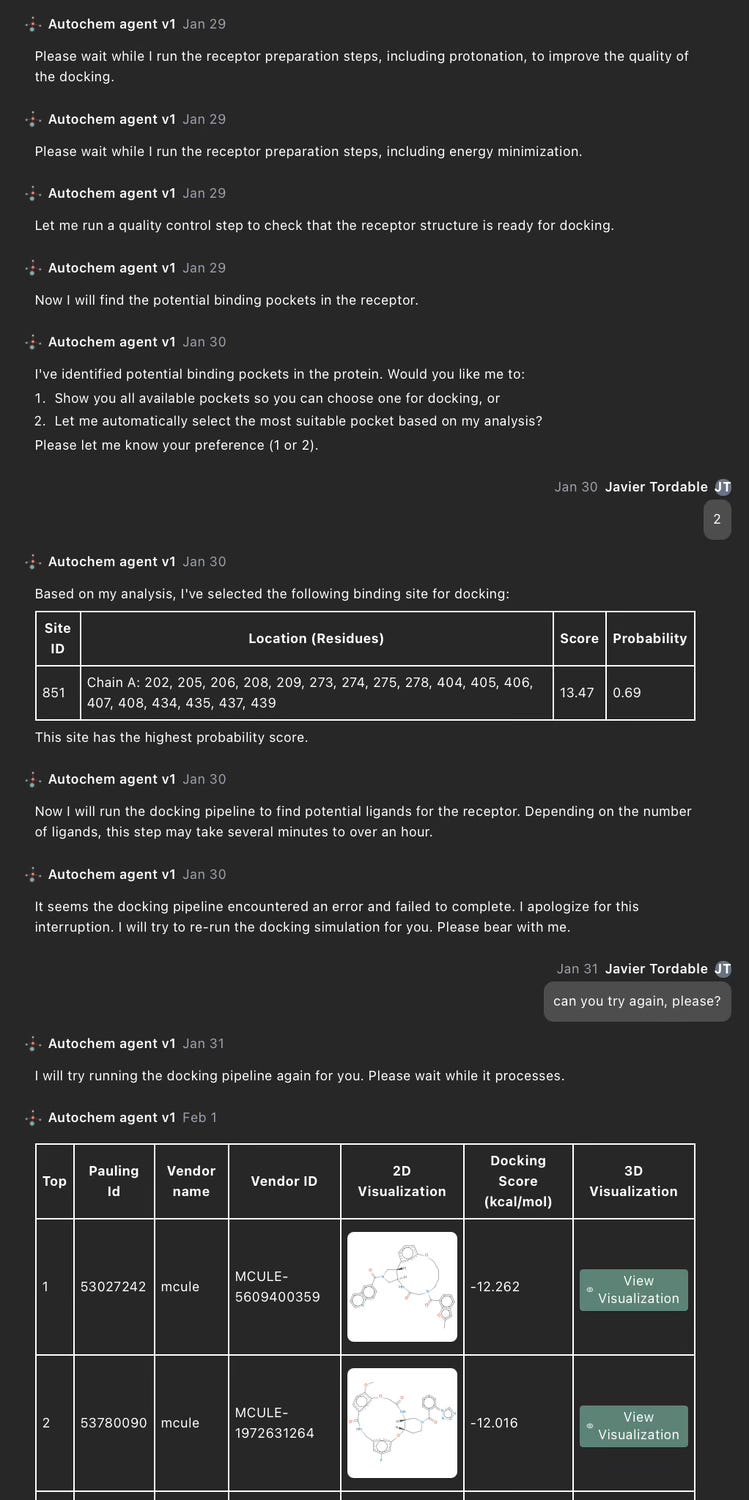
Hi! I'm doing vibe docking simulations for the cancer I'm interested in (JAK2V617F+ MPNs). The results have been fascinating. I use 1) claude cowork 2) openclaw w/ GPT 5.3.