

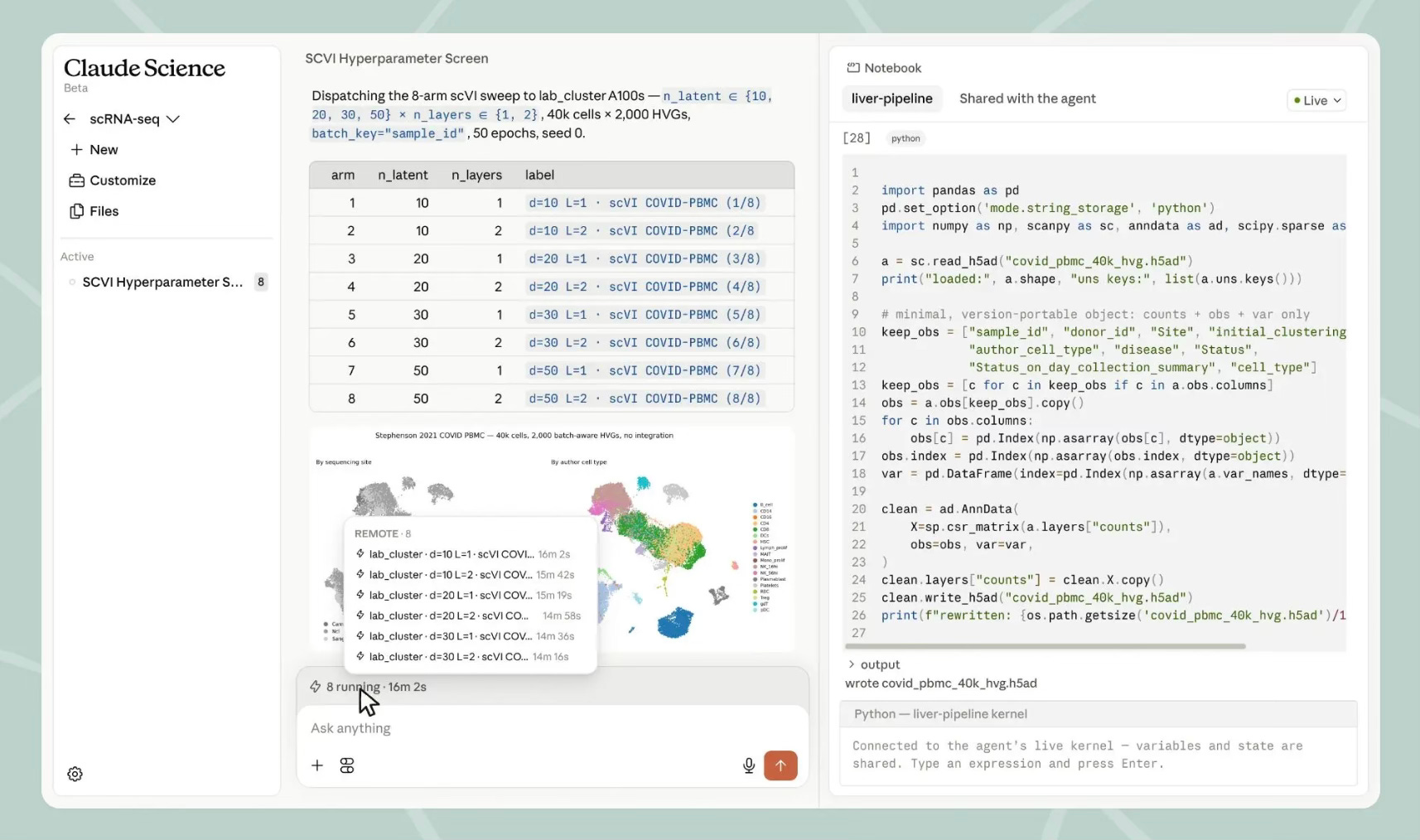
Anthropic released Claude Science this week, an AI workbench that folds proteins, queries sixty scientific databases, runs pipelines on your own cluster, and ships every figure alongside the exact code that produced it. It is a nice piece of engineering and a gift to the field. Full credit to them. I expect it will make good scientists faster.
But I suspect we will see the biggest life sciences discoveries coming from smaller companies. Anthropic entering this space changes who has the tools. It does not change who has the incentives, and incentives are what decide where drugs actually come from.
Let’s do the numbers. A true blockbuster peaks around three to five billion dollars a year and takes ten to fifteen years to get there. Set that against a two trillion dollar market cap and it is a rounding error, twenty or thirty basis points of enterprise value in the best case. There is no drug outcome large enough to move a trillion dollar stock.
So inside a tech giant, a therapeutics program is an orphan from the first day. It never wins a budget fight against Ads, Cloud, or the next frontier model, because those are where the marginal executive hour actually compounds. Calico had billions in committed capital and Art Levinson at the top, and after twelve years it has almost nothing in the clinic. The money was there. But the results are not.
Now let’s look at timelines. Leadership at a large company turns over every four to six years. A drug takes ten to fifteen. No single champion can carry a program across a full development cycle, so sponsorship changes hands before the science pays off, every time. Each new executive inherits a slow, expensive line item they did not start and cannot claim, and the rational move is always to trim it. The program dies of neglect long before it dies of bad science.
There is also an operating muscle problem that runs deeper than patience. Tech companies are built on cheap, fast, high volume feedback. Ship it, test it, read the result in hours, iterate. Biology runs on expensive, slow, noisy feedback. A mouse study is months. A trial is years. You cannot A/B test a clinical endpoint. The exact reflex that makes a software company great, ship and measure and move, is close to useless in a discipline where the measurement takes a year and comes back ambiguous. Worse, that reflex reads biology’s normal pace as failure and pulls the plug on programs that were proceeding exactly as biology proceeds.
Pharma will not close the gap for them either. The best data and the best partnerships stay away because a tech giant is always a potential competitor wearing a partner’s coat. Hand your proprietary trial data to a company that monetizes data, sells you cloud, and could vertically integrate against you next quarter, and you are training your own future rival. So the assets and the collaborations that would make a big tech bio effort work are precisely the ones that never flow in.
Then there is talent. The scientists who actually find drugs want three things: real equity upside, scientific autonomy, and their name on the discovery. Inside a large company they get a diluted stock grant where a bio win does not register, IP owned by the mothership, and promotion committees that do not understand the work. You cannot recruit or keep founder grade scientists into that structure. A focused startup offers all three by construction, which is why the talent routes there.
None of this is a knock on Anthropic. They are creating great technology. That is the correct lane, and it is the one lane in this whole space where a large technology company holds a durable advantage. Tooling scales. It carries near zero marginal cost, it rewards fast iteration, it imports no FDA liability, and it serves the entire industry at once, so the orphan math flips from a curse into the whole point. NVIDIA understood this with BioNeMo. Anthropic understands it with Claude Science. The value of a platform grows with every lab that adopts it, and no single failed trial can sink it.
So the division of labor is becoming clear. The tooling belongs to the technology companies, who can build it at a scale and quality no startup could match alone. The molecules belong to the small, fast, equity driven teams who can concentrate a decade of conviction on a single target and keep the people who care about it in the room the entire time.
Congratulations to Anthropic for building something genuinely useful, and for building the right thing. The breakthroughs it enables will show up on someone else’s cap table, and that someone will be small.