
First in a series where we take a well-known drug target, hand it to Autochem with nothing but its identifier, and show you exactly what our AI agent does with it step by step, nothing hidden.
When Pfizer’s Paxlovid became one of the defining drugs of the COVID-19 pandemic, its molecular target was SARS-CoV-2’s main protease (Mpro), also known as 3CLpro. The virus cannot replicate without it, and nirmatrelvir, Paxlovid’s active component, works by forming a covalent bond to the enzyme’s catalytic cysteine [1]. That made Mpro one of the most intensely studied enzymes of the last decade, and a fitting target to open this series: famous, well-characterized, and structurally clean.
So we did something deliberately simple. We opened Autochem and gave it one thing a PDB ID, 6WQF, the first crystal structure of SARS-CoV-2 Mpro ever deposited [2] and let it run (non-covalent docking).
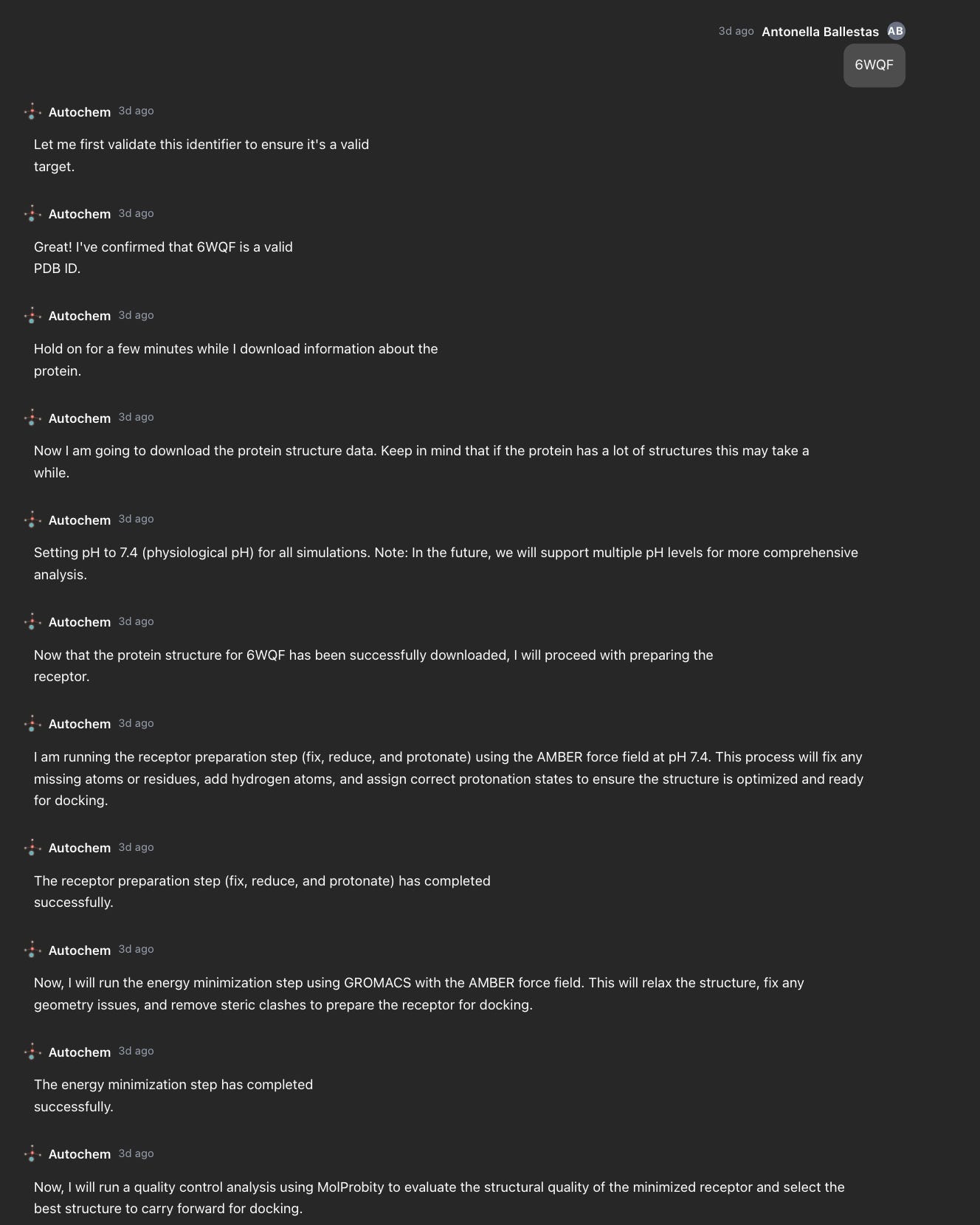
Figure 1. Starting an Autochem project with a single input the PDB ID 6WQF, the first crystal structure of SARS-CoV-2’s main protease. Everything that follows happens in one conversation.
The unglamorous part is where quality is won
Handing an agent a protein structure is easy. Turning a raw crystal structure into something you can actually dock against is where most of the real work and most of the errors live. Autochem handled this on its own:
Pulled the structure and set protonation to physiological pH 7.4
Prepared the receptor with the AMBER force field [3] fixing missing atoms (PDBFixer, Reduce) and adding hydrogens, assigning correct protonation states
Ran a energy minimization [4] to relax the structure and resolve steric clashes
Ran a MolProbity quality-control check [5] and carried forward the best modeled structure forward
None of this required a single instruction from us. This is the part a bench scientist can spend hours on, and it’s the part that quietly determines whether everything downstream can be trusted.
Finding the business end of the enzyme
Next, Autochem searched the receptor for binding pockets and ranked them [6]. It found eight. The top-ranked pocket scored 11.16 well ahead of the runner-up at 8.44. No ambiguity about where to dock.
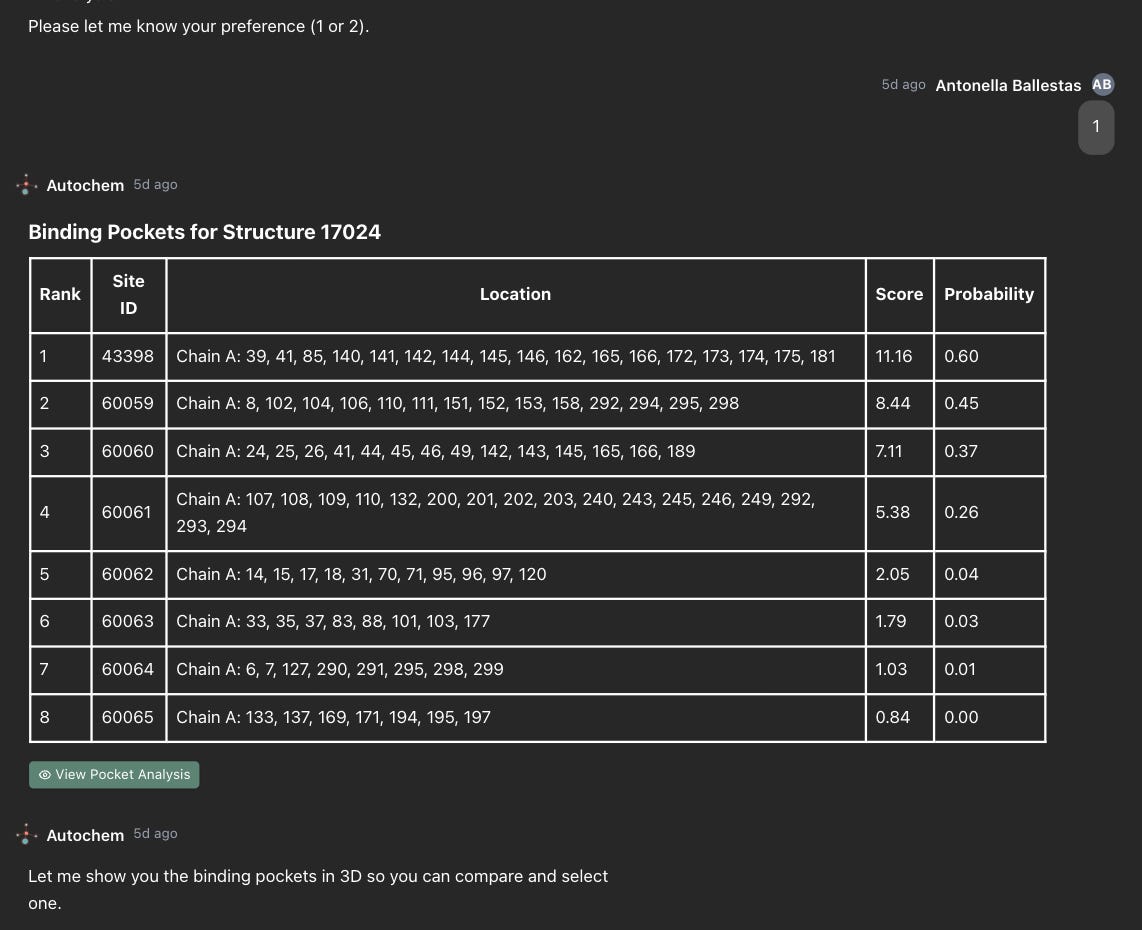
Figure 2.The binding pockets P2Rank detected on the Mpro structure, ranked by druggability score. The top-ranked pocket (score 11.16) stands well clear of the rest, leaving no ambiguity about where to dock.
What matters is where that top pocket landed. Its residues include His41, Cys145 and conservative Glu166 the catalytic dyad at the heart of Mpro along with the S1 and S2 subsites where Paxlovid itself binds [1, 2]. With no hints from us, the agent identified the exact functional site that decades of Mpro research converged on.
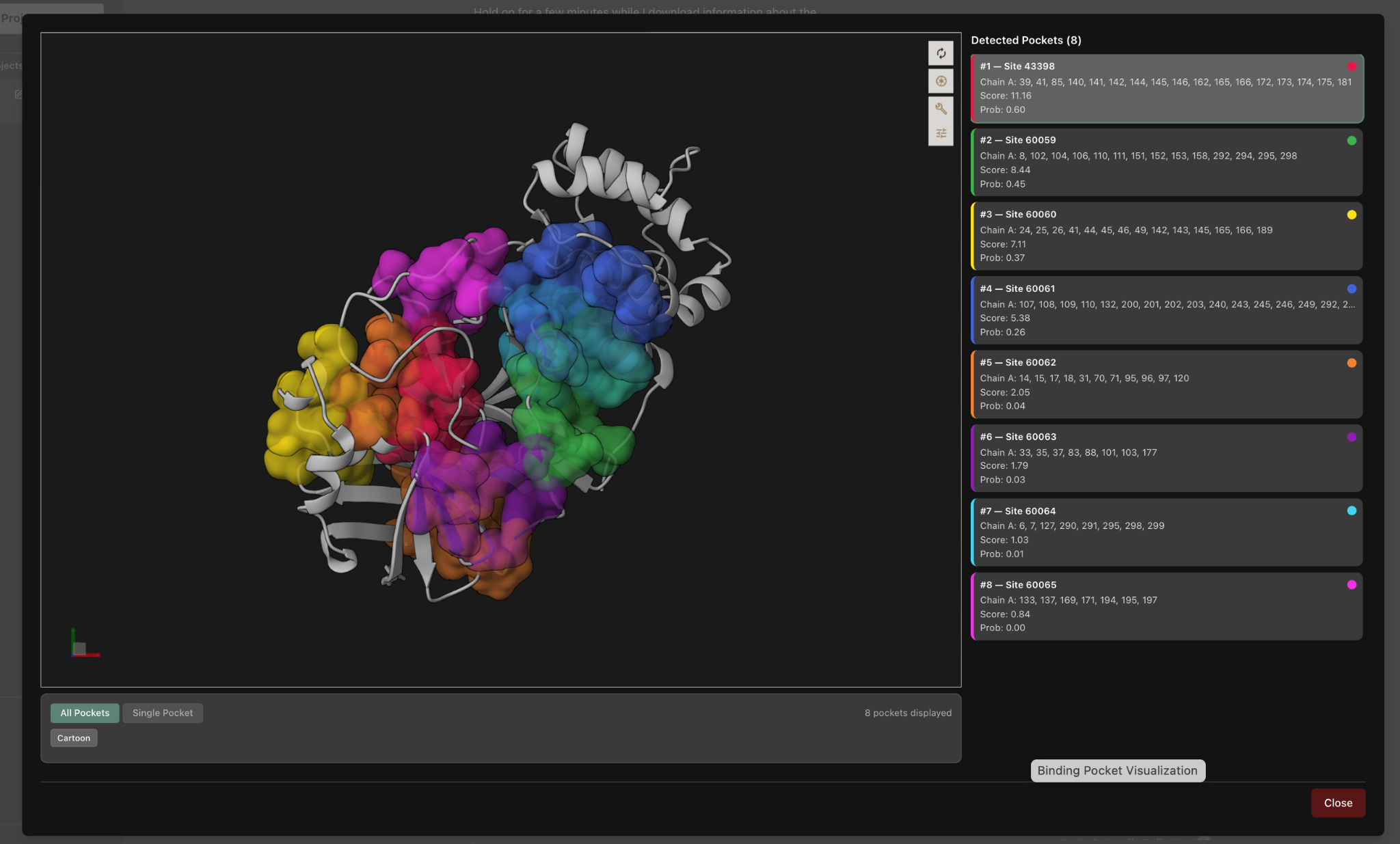
Figure 3. The eight binding pockets P2Rank detected on the Mpro structure, each shown in a distinct color and listed with its rank, score, and probability. The top-ranked pocket (#1, Site 43398, score 11.16) stands well clear of the rest it maps to the His41–Cys145 catalytic dyad, the enzyme’s active site, identified automatically.
Docking — and then the part most tools skip
With the pocket selected, Autochem ran a GPU-accelerated virtual-screening docking pipeline (Uni-Dock) [7] and returned a ranked set of candidate compounds, each with 2D and 3D structures
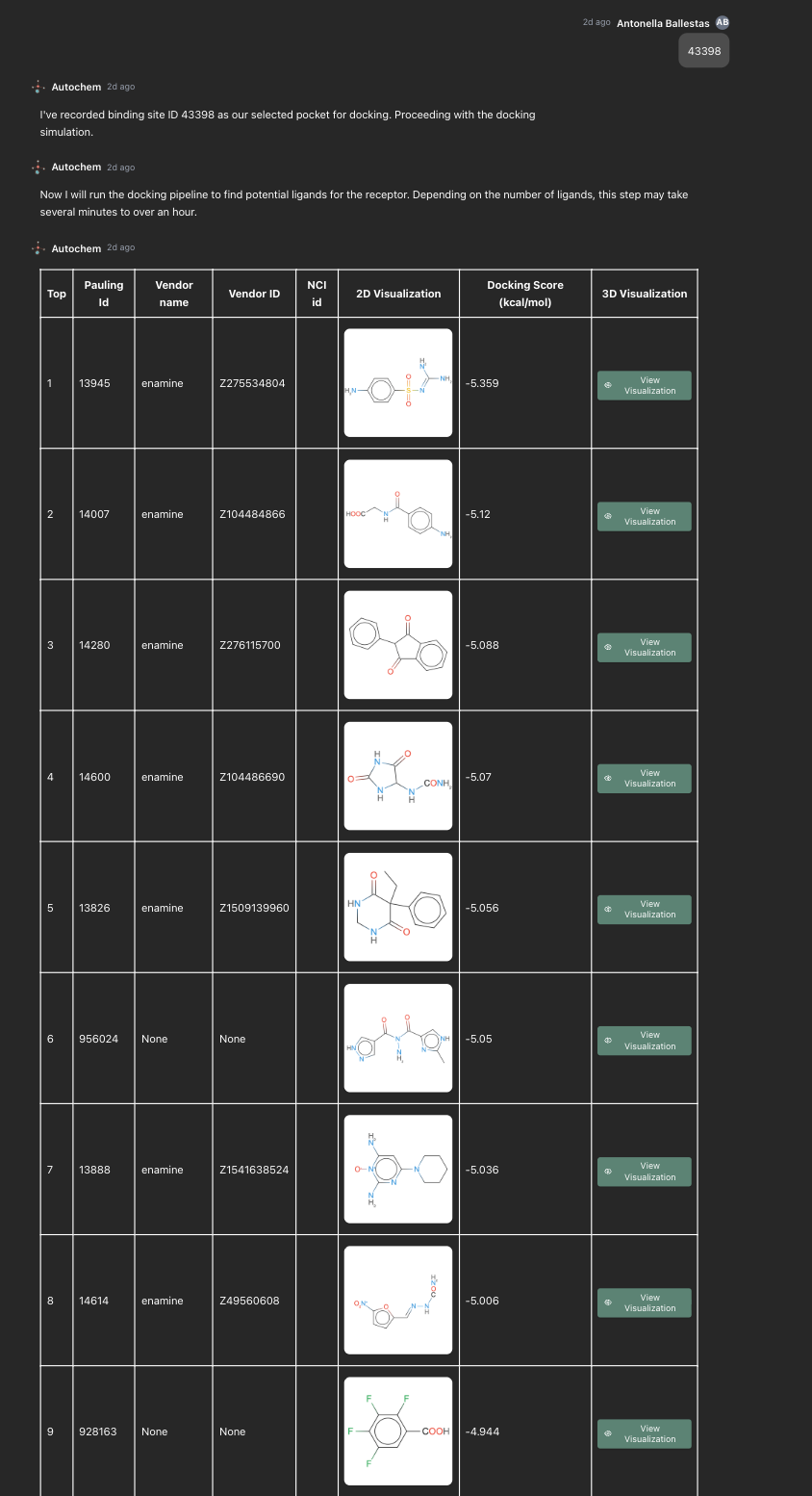
Figure 4. The docking output: candidate compounds from the screening library, ranked by vina score, each with its 2D structure, docking score, and a 3D view of the predicted pose.
But a docking score on its own is close to meaningless; a good-looking number can come from a pose that is physically nonsense. So the pipeline didn’t stop there. It added two independent layers of analysis:
PLIP [8] mapped the specific protein–ligand interactions for each top compound hydrogen bonds, hydrophobic contacts, π-stacking etc. So you can see how a candidate sits in the pocket, not just a number next to it.
PoseBusters [9] checked every top pose against a battery of physical and chemical validity tests: bond geometry, planarity of aromatic rings, protein–ligand clashes. All of the top poses passed.
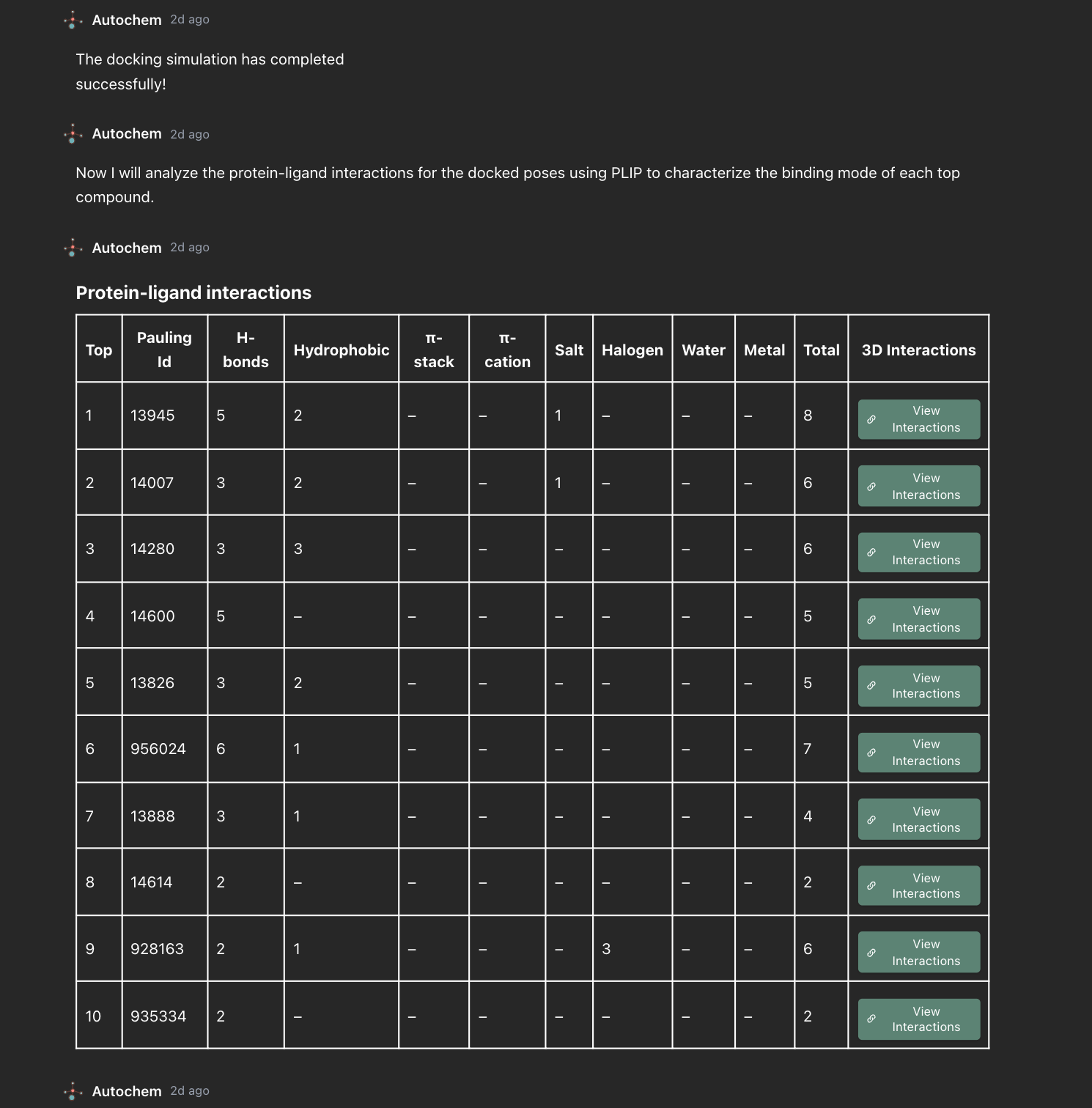
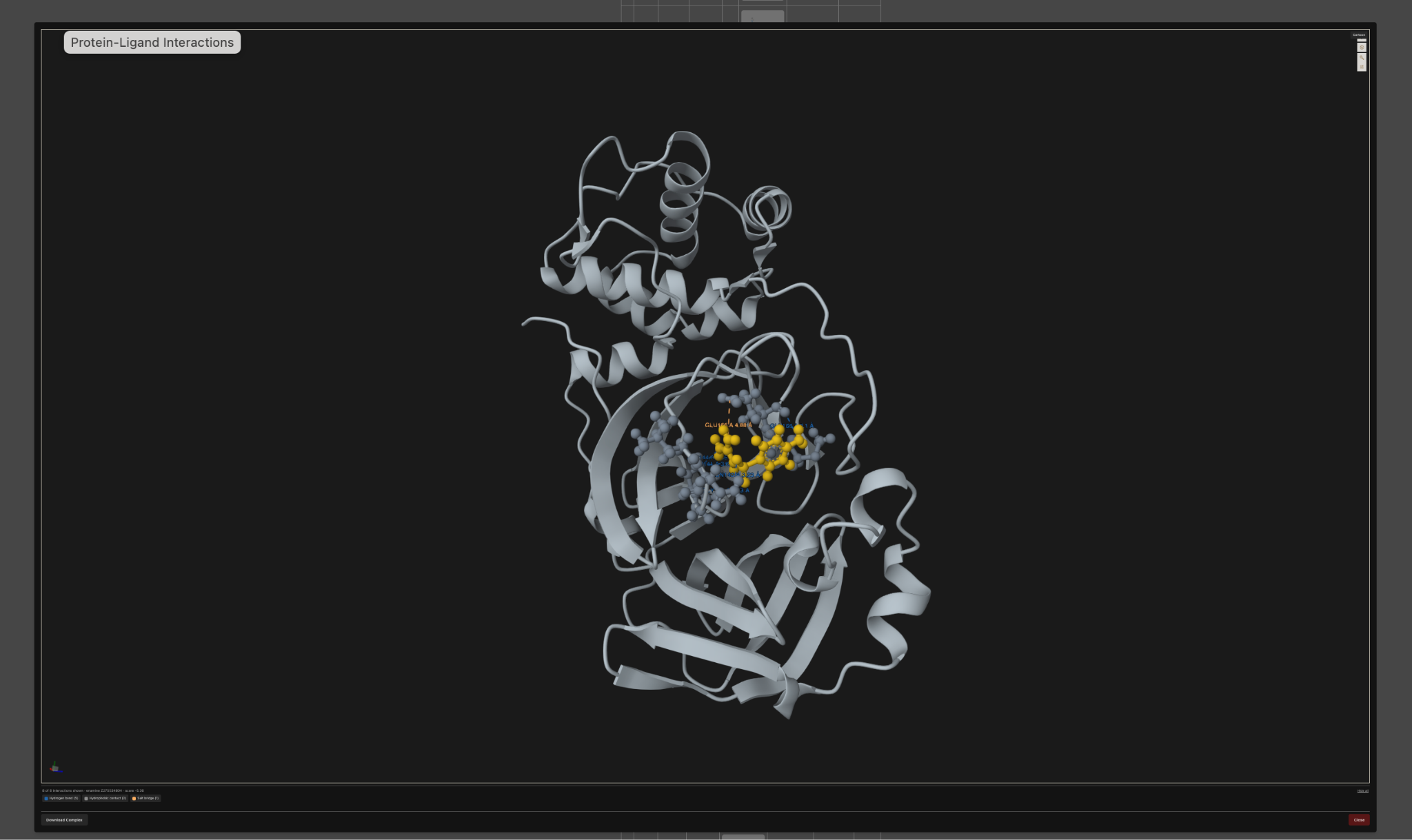
Figure 6. PLIP profiles the interactions between the top-ranked compound and the Mpro active site: 5 hydrogen bonds, 2 hydrophobic contacts, and 1 salt bridge. Labeled residues (e.g. conservative Glu166) show the ligand engaging the same substrate-binding subsites targeted by known Mpro inhibitors.
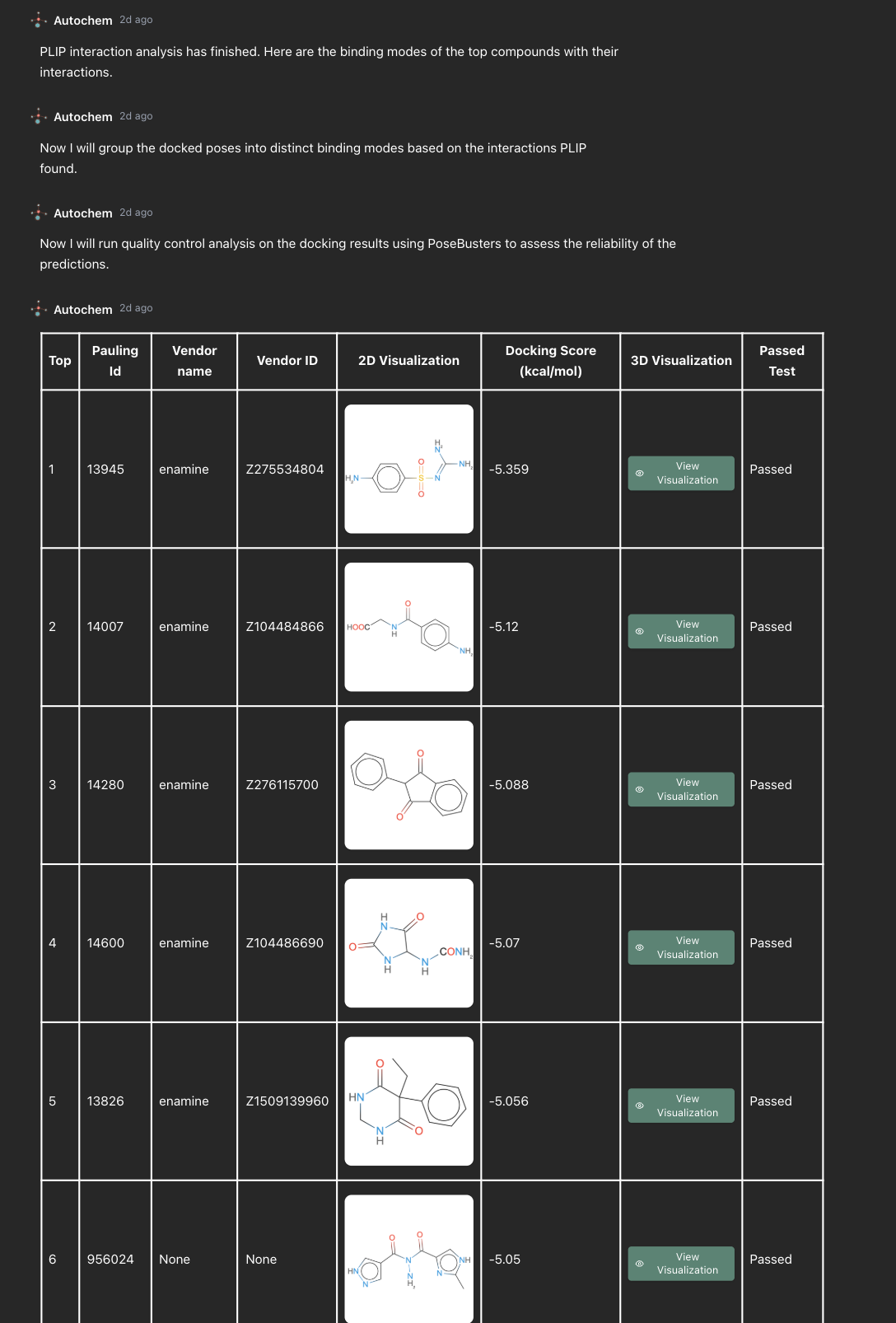
Figure 7. PoseBusters runs a final physical-validity check on each top pose testing bond geometry, aromatic-ring planarity, and protein-ligand clashes. Every top compound passed, confirming the predicted poses are physically realistic, not just high-scoring.
That last step is the one we care about most. A pipeline that hands you scores without checking whether the poses are physically real is handing you a liability. In fact, this is exactly where recent benchmarks have shown many AI docking methods fall short producing low-RMSD poses that are physically implausible [9]. Validation isn’t a footnote at Pauling.AI it runs inside every job.
Why this matters
The goal was concrete: find molecules that engage Mpro’s catalytic site the His41–Cys145 dyad the virus depends on. Autochem did exactly that. Starting from a single identifier, it ranked the active-site pocket first, docked a library against it, and then used PLIP to confirm that the top-ranked compounds sit squarely in that catalytic pocket forming hydrogen bonds with Glu166 and the surrounding S1–S2 subsites, the same region where approved Mpro inhibitors bind. PoseBusters confirmed every one of those poses is physically valid.
That’s the loop Autochem closes: from a target, to candidates that engage the right site, to validated evidence of how they bind receptor prep, QC, pocket detection, docking, interaction analysis, and pose validation, in one continuous conversation.
Next in the series: 1HXW - Proteasa de VIH-1 il caso che ha sancito la progettazione di farmaci basata sulla struttura
References
Owen, D. R. et al. An oral SARS-CoV-2 Mpro inhibitor clinical candidate for the treatment of COVID-19. Science 374, 1586–1593 (2021). https://doi.org/10.1126/science.abl4784
Jin, Z. et al. Structure of Mpro from SARS-CoV-2 and discovery of its inhibitors. Nature 582, 289–293 (2020). https://doi.org/10.1038/s41586-020-2223-y (PDB ID: 6LU7)
Maier, J. A. et al. ff14SB: Improving the Accuracy of Protein Side Chain and Backbone Parameters from ff99SB. J. Chem. Theory Comput. 11, 3696–3713 (2015). https://doi.org/10.1021/acs.jctc.5b00255
Abraham, M. J. et al. GROMACS: High performance molecular simulations through multi-level parallelism from laptops to supercomputers. SoftwareX 1–2, 19–25 (2015). https://doi.org/10.1016/j.softx.2015.06.001
Williams, C. J. et al. MolProbity: More and better reference data for improved all-atom structure validation. Protein Sci. 27, 293–315 (2018). https://doi.org/10.1002/pro.3330
Krivák, R. & Hoksza, D. P2Rank: machine learning based tool for rapid and accurate prediction of ligand binding sites from protein structure. J. Cheminform. 10, 39 (2018). https://doi.org/10.1186/s13321-018-0285-8