
How Autochem Screens 10M Molecules Without Sacrificing Accuracy
The Two-Stage Docking Strategy
Large-scale virtual screening is not just a question of how many molecules you can dock.
It is a question of how quickly you can move through chemical space without turning the output into noise.
Docking 10 million molecules can produce a long list of scores. But a long list of scores is not the same as a useful hit list. For teams making decisions in early discovery, the real challenge is knowing which compounds deserve deeper attention — and which ones should be filtered out early.
Autochem handles this through a two-stage docking strategy.
First, the system runs a fast large-scale screen to explore broad chemical space. Then, it applies more detailed re-docking to the most promising candidates, where pose quality and score refinement matter most.
The goal is simple:
screen broadly, refine selectively, and produce a shortlist researchers can actually use.
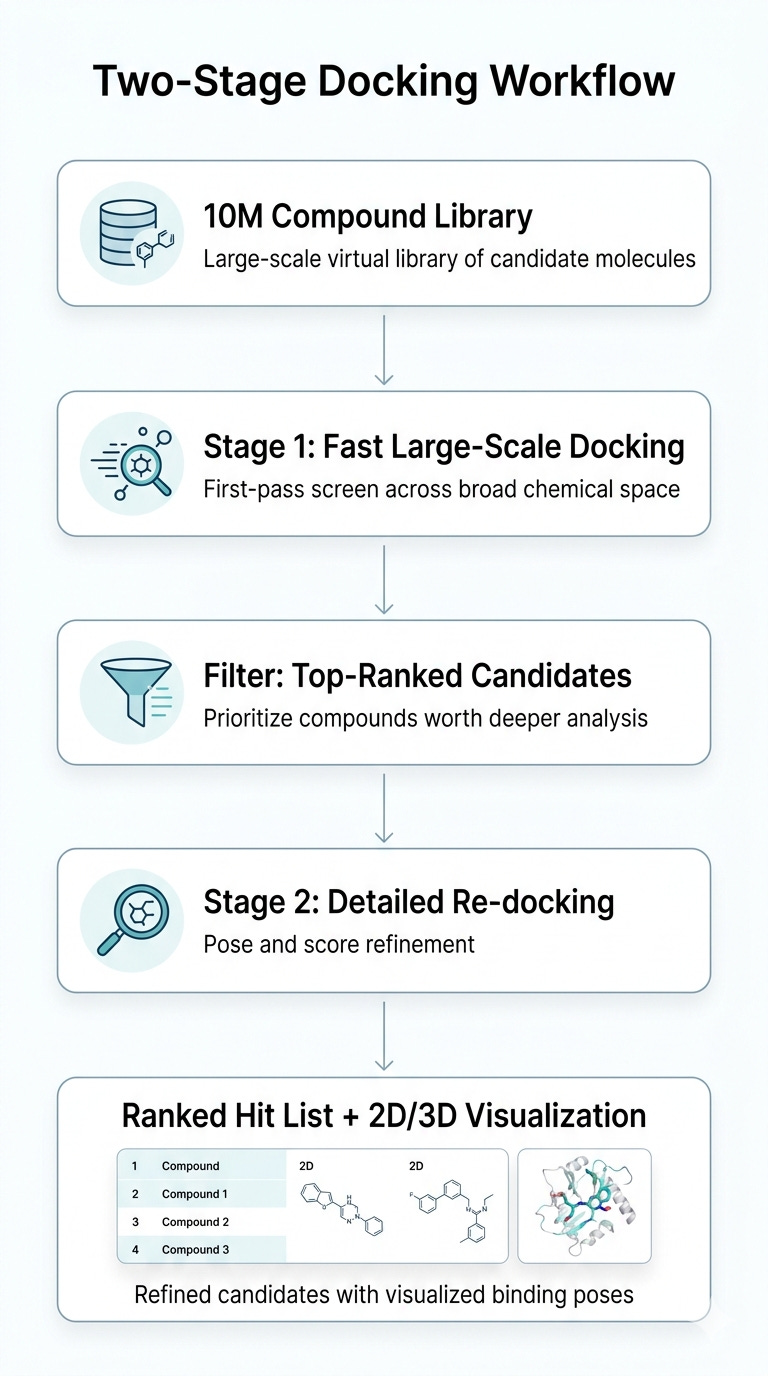
Autochem separates large-scale exploration from detailed refinement, using a two-stage docking strategy to move from millions of molecules to a prioritized hit list.
Why Brute-Force Docking Is Not Enough
At 10M scale, brute force is rarely the smartest strategy.
Running every compound through the most detailed docking setup from the beginning can be slow and computationally expensive. But relying only on a fast first-pass score can also be risky. Docking scores can be noisy. Poses can be unstable. Some compounds rank well for the wrong reasons.
That is why the workflow matters.
Autochem does not treat every molecule as if it deserves the same level of computational attention. Instead, it separates the process into two different questions.
The first question is:
Which compounds are worth keeping?
The second is:
Which of those compounds still look promising under closer inspection?
This distinction is what makes the two-stage strategy useful. It allows the system to move quickly through a large library, while reserving more detailed analysis for the compounds that have already passed the first filter.
Before Screening, the Structure Has to Be Ready
Docking accuracy does not begin with the docking engine.
It begins with the receptor.
Before screening starts, Autochem prepares the protein structure for docking. That includes setting physiological pH, protonating the structure, running energy minimization, checking receptor quality, and identifying potential binding pockets.
These steps matter because docking is highly sensitive to structural details. Missing hydrogens, incorrect protonation states, poor geometry, or a poorly defined binding site can all distort downstream results.
A two-stage docking strategy only works if the starting structure is reliable enough to support it.
That is why receptor preparation is not a separate administrative step. It is part of the scientific foundation of the screen.
tage 1: Fast Screening Across Broad Chemical Space
The first stage is designed for scale.
At this point, the goal is not to produce the final answer. The goal is to reduce the search space intelligently.
Autochem runs a fast docking pass across the large compound library to identify molecules with stronger predicted binding potential. This stage helps eliminate weak candidates early and narrows the field to a smaller set of compounds worth deeper evaluation.
For 10M-scale libraries, this is where speed matters most.
Without a fast first pass, teams can spend too much time and compute on compounds that are unlikely to advance. With it, the screen becomes a prioritization workflow rather than a raw compute exercise.
Stage 2: Re-Docking the Candidates That Matter
The second stage is designed for refinement.
Once the first-pass screen identifies promising candidates, Autochem applies more detailed re-docking to evaluate them more carefully. This helps refine the ranking and gives researchers a better basis for reviewing pose quality, score consistency, and potential protein-ligand interactions.
This is where the workflow becomes more selective.
Instead of spending maximum compute on every molecule, Autochem focuses deeper analysis on the subset of compounds most likely to be useful.
That is the core logic of the two-stage strategy:
broad exploration first, focused refinement second.
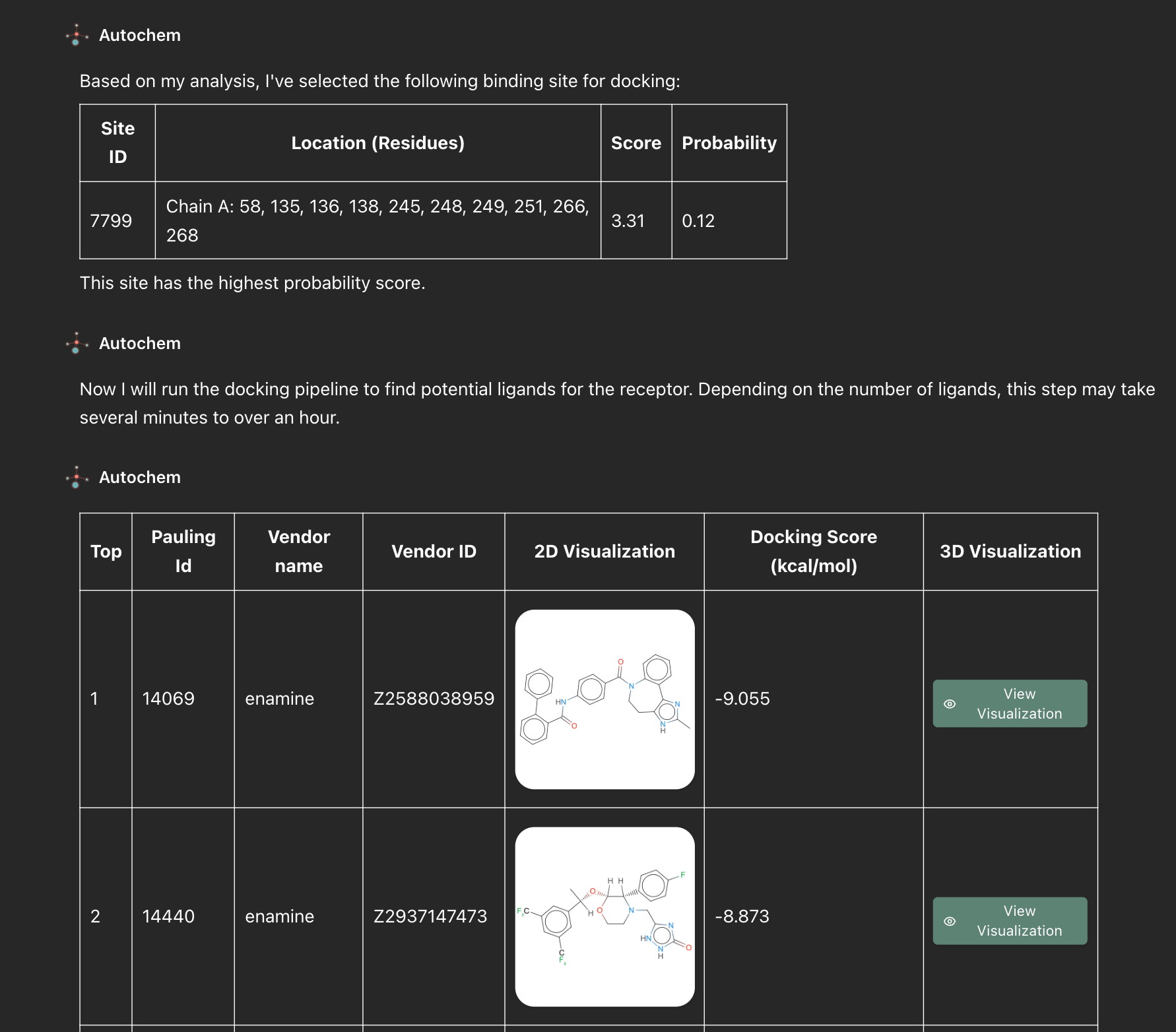
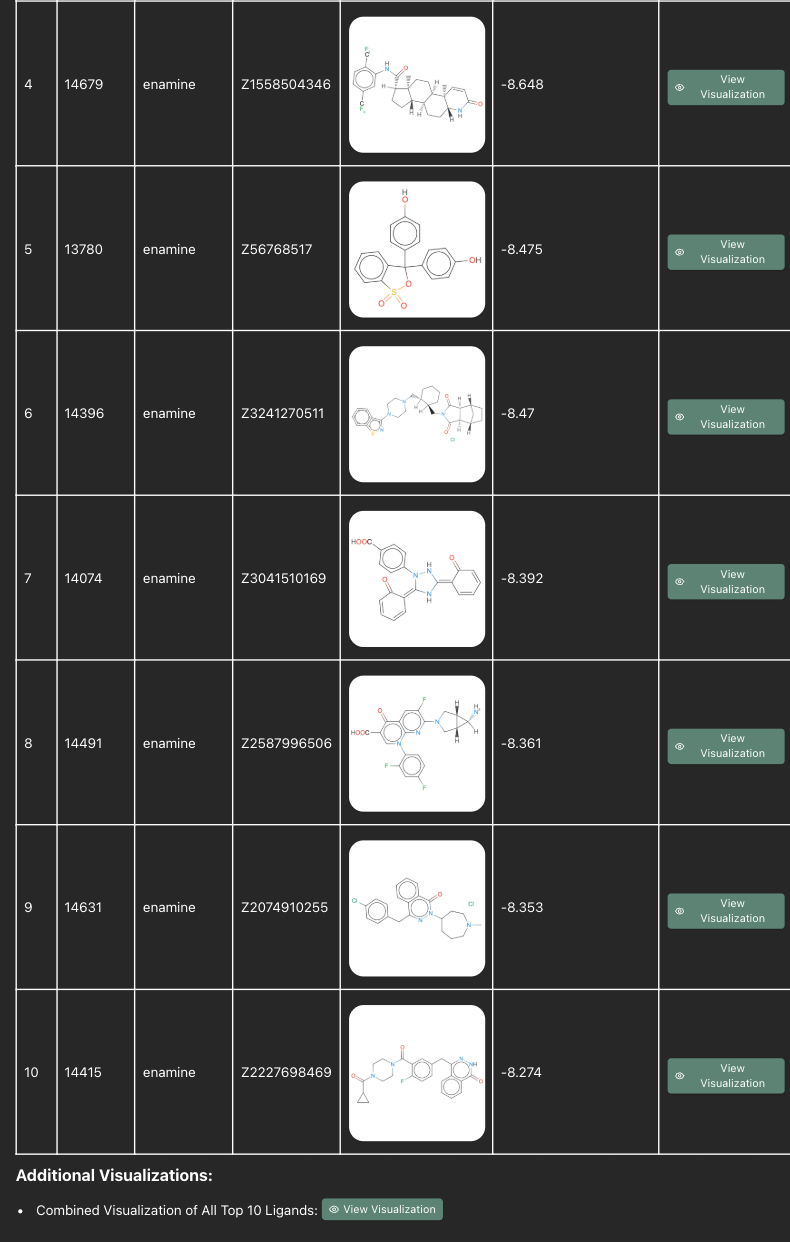
Autochem turns docking output into a ranked results table with compound identifiers, vendor information, 2D structures, docking scores, and access to 3D visualization.
From Scores to a Usable Hit List
The output of a large-scale screen should not be a folder full of files or a spreadsheet that requires days of manual interpretation.
It should be a shortlist researchers can act on.
After docking, Autochem organizes results into a ranked table that makes candidates easier to compare. Users can review compound identifiers, vendor information, molecular structures, docking scores, and 3D visualizations from the same workflow.
This matters because a docking score is only one part of the decision.
A molecule may rank well numerically, but researchers still need to inspect whether the predicted pose makes chemical sense. Does the ligand fit the pocket? Are the interactions plausible? Is the result worth advancing into deeper computational analysis or experimental validation?
By connecting ranking with visualization, Autochem helps teams move from raw screening output to structured decision-making.
Why This Strategy Matters
Large-scale virtual screening is valuable only when it produces results that can be trusted, interpreted, and prioritized.
The two-stage strategy helps prevent two common problems.
The first is spending too much compute too early, before knowing which molecules deserve attention.
The second is over-trusting fast docking scores without deeper review.
Autochem addresses both by separating scale from refinement. It screens broadly, filters intelligently, and then re-docks the most promising candidates with greater attention to pose and scoring quality.
The result is not just a faster screen.
It is a cleaner path from chemical space to decision-ready candidates.
Conclusion
Screening 10 million molecules should not mean sacrificing interpretability.
Autochem’s two-stage docking strategy is designed to make large-scale screening practical while preserving the quality needed for downstream decisions.
The workflow starts with receptor preparation, moves through fast first-pass screening, applies detailed re-docking to prioritized candidates, and returns ranked results that can be reviewed through 2D and 3D visualization.
Screen broadly. Refine selectively. Prioritize with confidence.
That is how Autochem turns large-scale docking into a usable hit selection workflow.