

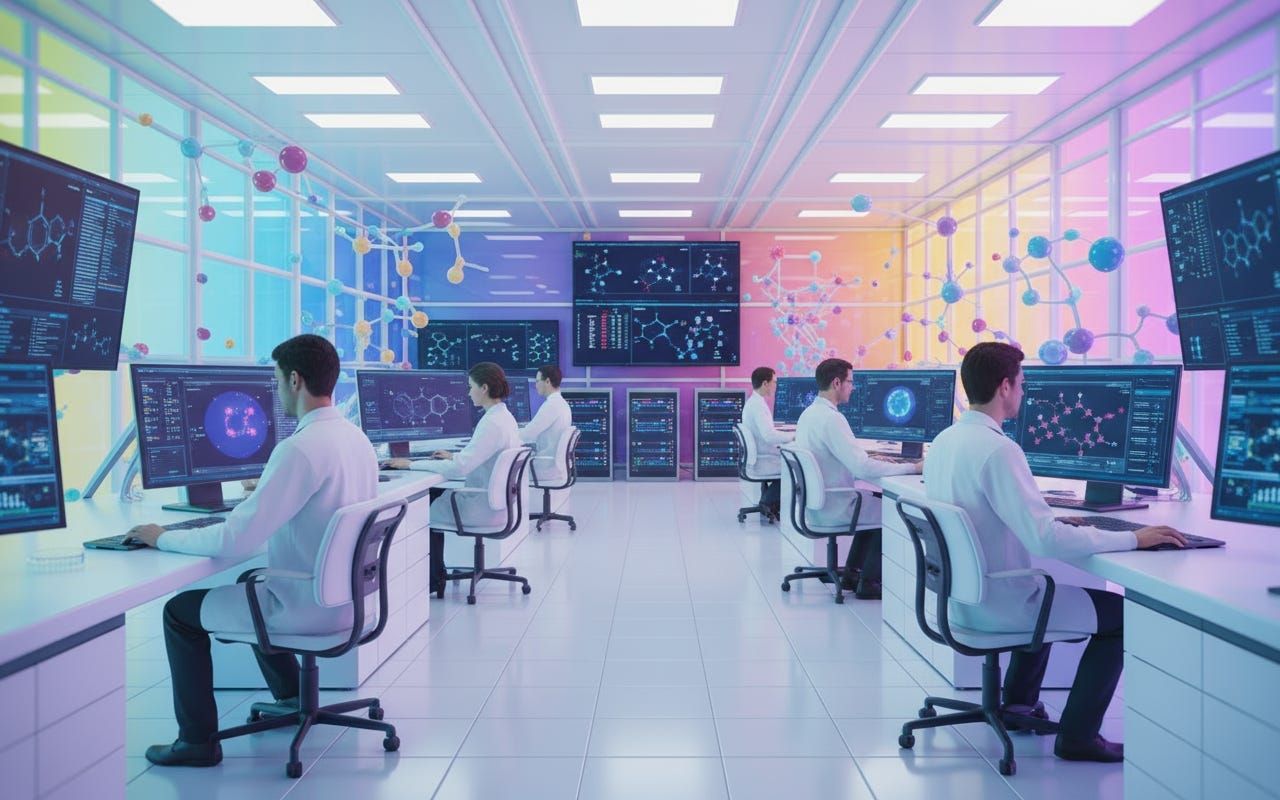
In the Last quarter of the year, we talked with 3 major pharmaceutical companies terminated their long-standing CRO contracts and they are replacing them with AI-Drug discovery technologies that deliver results in days and even just hours, instead of weeks and months. All of this for just 1-10th the cost.
This is not a future trend. Companies using AI for drug discovery are already automating the computational chemistry work that was outsourced just two years ago.
The global AI in drug discovery market, valued at approximately $1.8-3.6 billion in 2024, is projected to grow at a CAGR of 16.5-37.75% through 2035 [1,2,3]. Bimodal AI for drug discovery, combining physics-based methods with generative AI, has deeply changed the economics of computational chemistry.
In the past you needed a team of PhD computational chemists and 6-8 weeks per project; now it can be done autonomously in just a couple of nights.
If you’re still outsourcing early-stage modeling to computational chemistry CROs, you’re not just paying more, you’re falling behind competitors who’ve already made the shift.
Here is the reason why the traditional CRO model is dead, and what’s replacing it.
The Economics That Killed the CRO Model.
For a long time, pharmaceutical companies outsourced computational chemistry for simple reasons: Hiring PhD-level computational chemists costs $98,000-$174,000 annually in the United States [4,5], specialized software licenses run another $80K per seat, and building the internal expertise takes a good number of years.
The CRO value proposition was very simple: pay $25K-$100K per project, get expert analysis in 4-8 weeks, no long-term commitments. The global drug discovery services market, which includes computational chemistry CRO services, was valued at $65.84 billion in 2024 [6].
The trap and flaw of this model is that it didn’t scale with the pace of modern drug discovery.
A single computational chemist, even the most highly skilled ones, can only analyze 20-50 compounds per week manually. Multiply that across multiple projects simultaneously, add the communication overhead with the client, numerous quality control reviews, and take all of that and you get the industry-standard 6-8 week turnaround time [7].
AI drug discovery platforms have shattered this bottleneck entirely.
What usually takes a CRO team 6 weeks now it just happens in 6 hours, What costs $50k per campaign project now costs a fraction through for a platform subscription. What required sequential human decision making docking, MD validation, then ADMET prediction, now just runs as an integrated autonomous workflow with continuous cross-validation.
The math behind it is brutal for CROs: Companies using AI for drug discovery can run 100x more computational experiments per year at 1-10th the cost.
How Generative AI for Drug Discovery Changed Everything
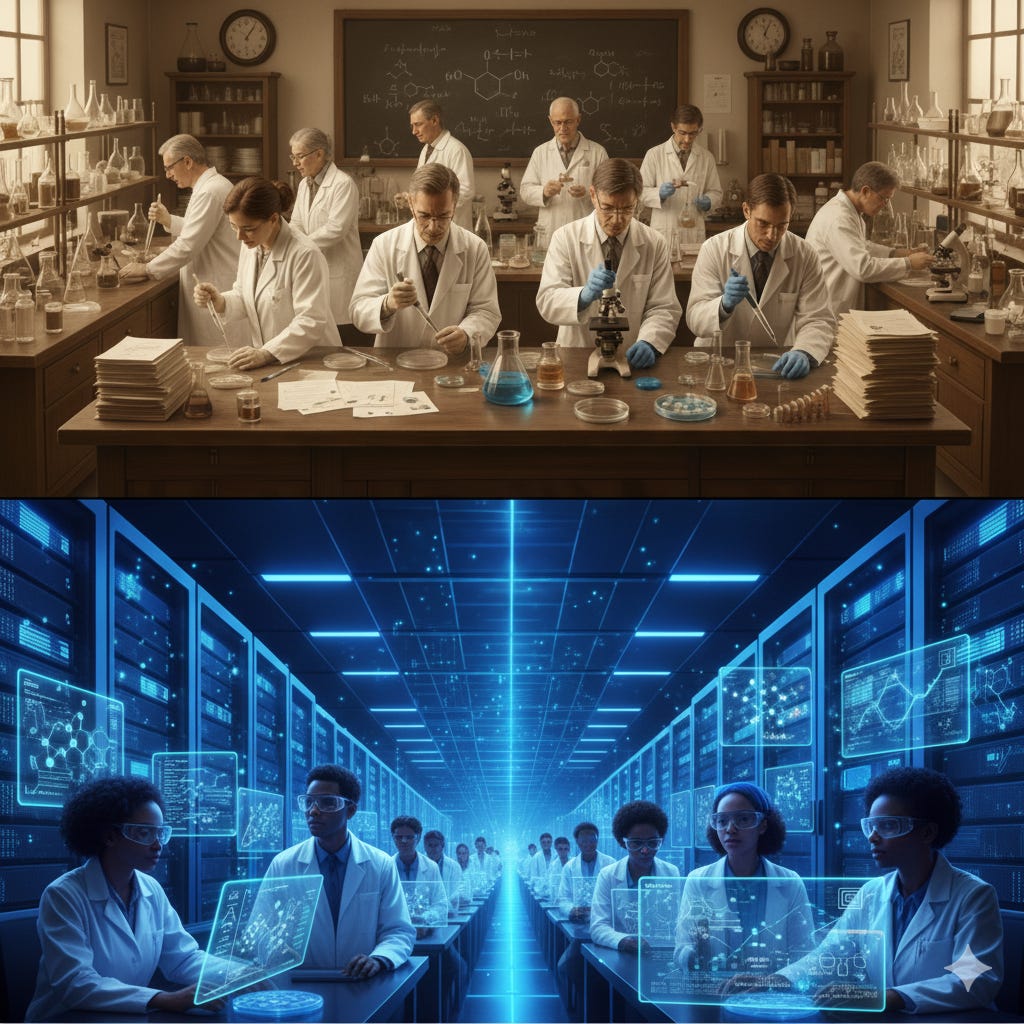
The Goal isn’t just faster computers or better algorithms, it is the fundamental automation of expertise.
Traditional computational chemistry required a human judgement at every step of the journey:
Which protein conformation is better for docking use?
Are these binding poses physically possible?
Do the MD results validate the docking prediction?
Should we trust this ADMET prediction for a novel scaffold?
Each decision point required a PhD-level computational chemist to interpret results, apply physics principles, and make judgment statements. This is the expertise bottleneck that CROs monetized.
Bimodal AI for drug discovery eliminates this bottleneck by embedding expertise directly into the workflow.
Modern AI drug discovery platforms combine two approaches:
Physics-based methods: Provide the rigorous foundation molecular dynamics simulations, quantum mechanical calculations, alchemical free energy methods. These aren’t approximations; they are literally solving the actual equations that govern molecular behaviors. Advanced methods like free energy perturbation (FEP) combined with molecular dynamics can predict binding affinities with chemical accuracy when properly implemented [8,9]
Generative AI models: Learn patterns from vast datasets of successful drugs, failed candidates, and experimental results. They are able to recognize when a docking pose is an artifact, when MD simulations need longer equilibration, when ADMET predictions are extrapolating dangerously beyond training data. Machine learning models trained on molecular dynamics trajectories can improve binding affinity predictions by incorporating structural dynamics information [10,11].
Taken together, these approaches create systems that don’t just run calculations they make expert judgments that used to require years of training.
Why This Transition Is Inevitable
The data just speaks for itself.
Benchmark studies show AI drug discovery platforms matching or exceeding human expert performance on standard computational chemistry tasks. According to recent reports, AI-discovered molecules have shown an 80-90% success rate in phase I clinical trials, substantially higher than previous average outcomes [1].
Docking accuracy, binding affinity predictions, ADMET property forecasts AI systems trained on large datasets consistently outperform traditional channels [12,13].
But it is not just about accuracy. It’s about consistency, speed, and scale.
A human expert has good days and bad days, makes different judgement calls on similar problems, a human can only focus on one project at a time. An AI system applies the same validation criteria every time, processes thousands of compounds simultaneously.
The economic pressure is inevitable and undeniable. Companies using AI for drug discovery achieve better results faster at lower costs. Competitors clinging to CRO-dependent workflows can’t keep this kind of pace.
The question here is not if the computational CROs are going to adapt, the question here is how long they have before they just become irrelevant.
Most will simply disappear as their client base adopts in-house AI capabilities and CRO contracts expire without renewal.
The Path Forward
For pharmaceuticals and biotech companies still depending on computational chemistry outsourcing, the transition to AI-Powered in house capabilities is really simple
Start with a pilot on routine virtual screening: Choose an upcoming project that you would normally send to a CRO. Run it through an AI drug discovery platform instead, compare results, turnaround time, and cost.
Expand systematically to core computational workflows: As confidence in the tool grows, extend AI automation to lead optimization, ADMET profiling, structure based design, Reduce CRO spend gradually, reserving contracts only for truly specialized work.
Build small internal teams to leverage AI tools: You will notice that entire departments of computational chemists are not necessary. Just a small number of scientists who understand biology and chemistry, empowered with AI platforms, can deliver more than a team of dozens doing manual analysis.
Companies that move quickly will benefit. Their models improve with each experiment, their scientists develop intuition for computational drug discovery, their timelines get tiny while the competitors wait on CRO deliverables.
The companies that delay face a different reality: falling behind on innovation, burning budget on obsolete outsourcing models, watching competitors iterate faster with better results.
Why We Built Pauling.AI
We built Pauling.AI to accelerate how fast scientists can find therapeutic molecules.
We saw incredibly talented scientists spending days setting up simulations, waiting weeks for results, and repeating the same cycles for months all for processes that could be accelerated dramatically.
We also saw companies paying huge fees for computational work that could be automated, and, more importantly, scientific progress being held back by technical limitations that already had solutions.
Pauling.AI is our attempt to solve this: a platform that automates computational drug discovery end-to-end, enabling scientists to go from idea to testable molecule much faster than ever before.
Not by replacing scientific insight, but by handling the computational execution autonomously so researchers can focus on the science that truly requires human creativity and judgment.
The future of drug discovery is about empowering scientists with AI tools that eliminate bottlenecks, accelerate iteration, and make computational chemistry expertise accessible to everyone working to develop better therapeutics.
References
[1] Global Market Insights. (2024). Artificial Intelligence in Drug Discovery Market Size Report, 2034. The global AI in drug discovery market was estimated at USD 3.6 billion in 2024, expected to reach USD 49.5 billion in 2034 at a CAGR of 30.1%. https://www.gminsights.com/industry-analysis/ai-in-drug-discovery-market
[2] Roots Analysis. (2025). AI in Drug Discovery Market Size & Share | Industry Report. The global AI in drug discovery market is projected to grow from USD 1.8 billion in 2024 to USD 13.4 billion by 2035 at a CAGR of 16.5%. https://www.rootsanalysis.com/reports/ai-based-drug-discovery-market.html
[3] Credence Research. (2025). AI in Drug Discovery Market Size, Growth and Forecast 2032. The AI in drug discovery market is projected to grow from USD 835 million in 2024 to USD 10,824.78 million by 2032 at a CAGR of 37.75%. https://www.credenceresearch.com/report/ai-in-drug-discovery-market
[4] Salary.com. (2024). Computational Chemist Salary. Average annual salary of $98,349 in the United States, ranging from $81,110 to $119,278. https://www.salary.com/research/salary/listing/computational-chemist-salary
[5] Glassdoor. (2025). Salary: Computational Chemist in United States. Average salary of $173,948 per year, with top earners making up to $275,403 (90th percentile). https://www.glassdoor.com/Salaries/computational-chemist-salary-SRCH_KO0,21.htm
[6] BioSpace. (2025). AI in Drug Discovery Market Size to Worth USD 16.52 Bn by 2034. The drug discovery market size accounted for USD 65.84 billion in 2024. https://www.biospace.com/press-releases/ai-in-drug-discovery-market-size-to-worth-usd-16-52-bn-by-2034
[7] Pharmacelera. (2018). Are medicinal chemistry CROs complementing their technology with computational chemistry? Discusses the standard turnaround times and workflows in computational chemistry CRO services. https://pharmacelera.com/blog/publications/are-medicinal-chemistry-cros-complementing-their-technology-with-computational-chemistry/
[8] Okamoto, Y., et al. (2020). Prediction of Protein–Ligand Binding Pose and Affinity Using the gREST+FEP Method. Journal of Chemical Information and Modeling, 60(11), 5382-5394. Demonstrates improved accuracy in binding affinity predictions using enhanced sampling methods. https://pubs.acs.org/doi/10.1021/acs.jcim.0c00338
[9] Gleeson, M.P., et al. (2010). Improved Ligand-Protein Binding Affinity Predictions Using Multiple Binding Modes. Biophysical Journal, 98(11), 2682-2691. Shows that molecular dynamics simulations with free energy calculations can greatly increase accuracy of binding affinity predictions. https://www.ncbi.nlm.nih.gov/pmc/articles/PMC2877349/
[10] Ye, Z., et al. (2023). Can molecular dynamics simulations improve predictions of protein-ligand binding affinity with machine learning? Briefings in Bioinformatics, 24(2), bbad008. Demonstrates that incorporating dynamic structural information from MD simulations can improve binding affinity predictions. https://academic.oup.com/bib/article/24/2/bbad008/6995375
[11] Min, Y., et al. (2024). From Static to Dynamic Structures: Improving Binding Affinity Prediction with Graph-Based Deep Learning. arXiv preprint arXiv:2208.10230. Presents Dynaformer, a graph-based deep learning model that learns from MD trajectories to predict binding affinities with state-of-the-art accuracy. https://arxiv.org/abs/2208.10230
[12] Aggarwal, R., et al. (2022). PLAS-5k: Dataset of Protein-Ligand Affinities from Molecular Dynamics for Machine Learning Applications. Scientific Data, 9, 548. Demonstrates the role of MD simulations in capturing conformational changes for accurate binding affinity prediction. https://www.nature.com/articles/s41597-022-01631-9
[13] Raed, A., et al. (2020). Predicting the impacts of mutations on protein-ligand binding affinity based on molecular dynamics simulations and machine learning methods. Computational and Structural Biotechnology Journal, 18, 439-454. Shows that machine learning methods using time-series features from MD simulations outperform traditional methods. https://www.sciencedirect.com/science/article/pii/S2001037019303757