

Everyone wants computational chemistry to be a vending machine. Put in a protein, get out a drug. The expectation is determinism: if the algorithm says this molecule binds, it binds.
It does not work that way. And the sooner we accept that, the sooner we can have an honest conversation about what computational methods actually do and why they are still transformative.
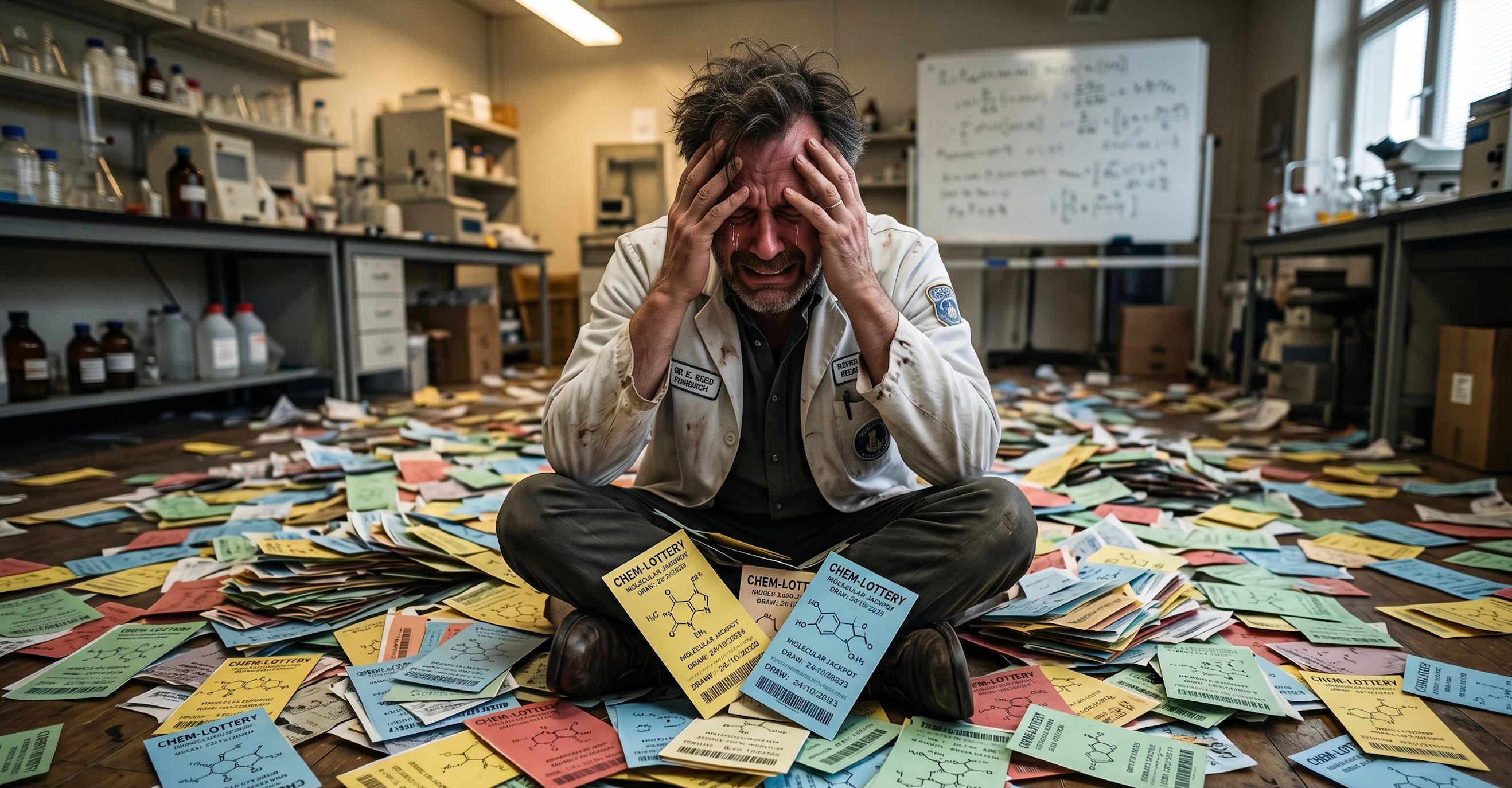
The myth of the perfect prediction
A docking score is a mathematical approximation of a physical interaction, computed under conditions that do not exist in a living system. The protein is usually rigid. The solvent is implicit. The scoring function was trained on a dataset that may have limited overlap with your target class. Entropy contributions are estimated, not measured. Receptor flexibility is ignored or crudely sampled.
The result is a number that correlates with binding affinity under ideal conditions. It is not a measurement. It is a hypothesis with a confidence interval that nobody prints on the output file.
This makes people uncomfortable. Investors want certainty. Project leads want a ranked list they can hand to a CRO without caveats. LinkedIn posts want a headline.
Here is the thing nobody says out loud: experimental science is not deterministic either.
Run the same biochemical assay on the same compound in the same lab on two different days and you will get slightly different IC50 values. Change the cell line. Change the temperature by half a degree. Change the batch of reagent. Results shift. Reproducibility in preclinical research is a documented, ongoing crisis. Studies have estimated that over half of published preclinical findings fail to reproduce. This is not controversy. It is the reality of working with biological systems that have more variables than any model can capture.
Chemistry is not deterministic either. Synthesis yields vary. Crystallization conditions are finicky. Polymorphs appear without warning. Medicinal chemists know this. They build intuition around it, and they iterate.
So the question is not whether computational chemistry gives you the exact right answer every time. The question is whether it makes the search faster and cheaper than the alternative.
Enrichment factor: the metric that actually matters
This is where enrichment factor comes in, and where the honest conversation begins.
Imagine you have a library of one million commercially available compounds. Somewhere in that library there are, say, 100 molecules that would show activity against your target in a biochemical assay. You do not know which ones. Nobody does. That is the whole problem.
If you pick compounds at random and test them, your hit rate reflects the base rate: 100 out of 1,000,000, or 0.01%. To find 10 hits you would need to test roughly 100,000 compounds. At scale, that is months of work and millions of dollars in reagents, plates, and labor.
Now run a computational screen. Dock the full library, filter by score, apply ADMET predictions, validate with molecular dynamics, check pose quality. The output is a ranked list. Take the top 1,000 compounds and send those to the lab.
If that top 1,000 contains 50 of your 100 true actives, your hit rate just went from 0.01% to 5%. That is a 500x enrichment factor. You found half the actives by testing 0.1% of the library.
The computational screen did not tell you which molecules are drugs. It told you where to look. It narrowed one million possibilities to one thousand. The biology still has to confirm everything. The chemistry still has to optimize everything. The clinic still has to validate everything.
The pipeline did not replace experimentation. It made experimentation affordable.
The right frame: fewer molecules, not fewer experiments
This reframe changes how you evaluate a computational chemistry platform. The question is not “did the algorithm identify a drug?” The question is “did the algorithm reduce the number of molecules I need to test to find my hits?”
A 100x enrichment factor means your experimental budget goes 100x further. A 500x enrichment factor means campaigns that were economically impossible become routine. Targets that no small biotech could afford to screen are suddenly accessible to a team of five people with cloud compute and a clear hypothesis.
This is the real value proposition of computational drug discovery. It is not about replacing the wet lab. It is about making the wet lab radically more productive by front loading the search with physics, statistics, and increasingly, AI that knows when its own predictions are unreliable.
At Pauling.AI, we treat every computational result as a hypothesis to validate, not a conclusion to announce. Our pipeline is designed to enrich, not to predict with false certainty. Because the teams that win in drug discovery are the ones who test fewer molecules, find more hits, and iterate faster than everyone else.
Computational chemistry is not deterministic. It is something more useful than that. It is a filter that turns an impossible search into a tractable one.